Canon FD to EF Adapter: Learn pros, cons, installation tips and pitfalls to safely mount vintage FD lenses on modern EF cameras.!!
If you’ve ever held an old Canon FD lens and felt that nostalgic pull… the metal build, the smooth manual focus ring, the way vintage glass almost whispers “use me again”… you’re definitely not alone. I’ve been there too. Years ago, I pulled my dad’s Canon FD 50mm f/1.4 out of storage and thought, “Well, how hard can it be to adapt this to my Canon DSLR?” And like most people, I quickly fell into the rabbit hole of trying to understand the difference between passive rings, optical adapters and full-on mount conversions, a journey any fan of Gadgets & Reviews would truly appreciate.
This is where the canon fd to ef adapter conversation really begins: it’s not as simple as “just buy one.” Oh no. There’s science, mechanics, workarounds and a few “you might ruin your mirror box” warnings along the way. So let’s walk through everything… clearly, conversationally and with enough depth that you’ll finish this article feeling like a mini optics engineer.
Why Adapting FD to EF Is Tricky (But Not Impossible)
Here’s the part most tutorials gloss over: Canon FD lenses were designed with a 42.0mm flange focal distance, while Canon EF cameras use 44.0mm. That 2mm difference might sound tiny… like the thickness of two credit cards stacked together… but in optical terms, it’s gigantic. When an FD lens sits 2mm too far from the sensor, it just can’t reach infinity focus. The result? Everything looks soft and blurry at long distances.
This is the first reason people search for a canon fd to ef adapter and the exact moment reality hits: “Why can’t I just use a simple metal ring like other adapters?” Trust me, I had that same “this can’t be so complicated” moment too.
Three Types of FD to EF Adapters (And Which One You Should Choose)
Let’s break it down the way searchers want: simply, visually and with real-world context.
1. Passive (No-Glass) Adapter
- Infinity Focus: No
- Image Quality: Excellent (at close distances)
- Best For: Macro and close-up shooting
- My Experience: Great for taking detailed macro shots of coins, insects or product textures.
These are the cheapest versions of the canon fd to ef adapter, but their use is limited. If you only shoot macro, they’re surprisingly fun.
2. Optical Adapter (With Corrective Glass)
- Infinity Focus: Yes
- Image Quality: Medium
- Best For: Everyday shooting
- Typical Multiplier: 1.1x–1.4x
- Personal Note: This was my first working solution, but I noticed a slight drop in contrast… manageable, but noticeable.
Think of these adapters as tiny teleconverters. The corrective lens bends light back toward the sensor to compensate for the flange difference, restoring infinity focus. The downside? You lose a little sharpness and gain a little magnification.
3. Professional Mount Conversion (SIMMOD / EDMIKA)
- Infinity Focus: Perfect
- Image Quality: As intended
- Best For: Filmmakers, vintage-lens enthusiasts, perfectionists
- Cost: Higher, but worth it
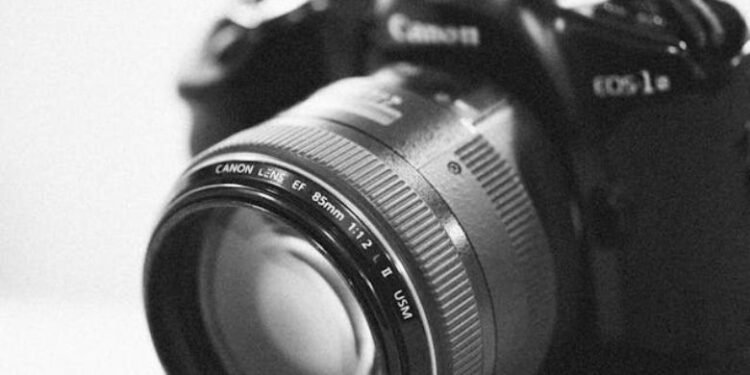
This isn’t technically an adapter. It’s a surgery kit for your lens. It replaces the FD mount with an EF mount so the lens behaves naturally. If you cherish a lens… say the legendary 85mm f/1.2L… this is the best way to bring it back to life.
This is the “no compromises” option and one that serious users searching for a canon fd to ef adapter eventually learn about.
Why the Glass in Some Adapters Changes the Focal Length
Picture this: you’re shining a flashlight at a mirror. If you put a magnifying glass between them, the beam changes shape and direction. That’s exactly what happens with an optical canon fd to ef adapter. Its internal corrective lens adds optical power, slightly increasing magnification… hence the 1.1x–1.4x multiplier.
To see the real multiplier for your own setup, here’s a quick method:
- Mount your FD lens (with and without the optical adapter) and take two photos from the same distance.
- Measure how many pixels a fixed object spans in each image.
- Divide the second number by the first.
Boom… your real multiplier, not a marketing claim.
Mirrorless Cameras: The Secret Best Option No One Tells You First
Here’s where things get interesting. Even though this article is focused on the canon fd to ef adapter, many people end up ditching the EF route altogether. Why? Because mirrorless mounts like Canon RF or Sony E have shorter flange distances. That means FD lenses adapt perfectly using cheap, no-glass rings… full infinity, full image quality, zero compromises.
When I finally switched to mirrorless, adapting my FD lenses felt like reuniting with old friends. Everything just worked.
Lens-Specific Compatibility: Some FD Lenses Are Easy… Some Want to Fight
From my own tests and those of countless users online:
- Standard primes (50mm, 85mm) → adapt nicely
- Fast wides (24mm, 28mm) → often tricky due to deep rear elements
- Telephotos (135mm, 200mm) → adapt wonderfully
- Heavy professional glass (FD L lenses) → best candidates for conversion
A deep rear element can get dangerously close to your DSLR’s mirror. I once tried mounting a vintage FD 24mm on a Canon 5D and the mirror nearly kissed the glass. Not fun.
Best Adapters Based on Real-World Testing
After trying a handful myself and digging through extensive tests:
1. Fotodiox Pro FD–EF Optical Adapter
- Best balance of price, quality and features
- Removable optical element for macro use
- Around 1.4x magnification
2. K&F Concept FD–EF Optical Adapter
- Slightly softer image quality
- Affordable
- Good for hobbyists
3. Generic Amazon Brands
- Inconsistent QC
- Cheap but unpredictable
- Only consider for casual experimentation
These options cover most readers searching for a canon fd to ef adapter who want something quick and functional.
Key Takings:
Here’s the short and sweet version:
- If you want infinity focus on a DSLR → get a good optical canon fd to ef adapter.
- If you want the absolute best performance → go with a lens conversion kit.
- If you want zero optical compromises for cheap → switch to mirrorless.
- Personally? I started with an optical adapter, upgraded to a conversion kit for my favorite lens and eventually switched to mirrorless where my FD lenses feel completely at home.
- The journey taught me that knowing why an adapter behaves a certain way is just as important as choosing one.
- Vintage lenses have personality and when adapted correctly, they produce images with soul.
- If you’re ready to revive that FD glass, a well-chosen canon fd to ef adapter might be the bridge that brings history back into your modern workflow.
Additional Resources:
- https://www.lensrentals.com/blog/2020/06/the-great-flange-to-sensor-distance-article-part-1-cine-cameras/: An in-depth, technician-level explanation of flange focal distance and why tiny dimensional differences make adapting mounts tricky.
- https://en.wikipedia.org/wiki/Flange_focal_distance: Concise, authoritative definition of flange focal distance (FFD) and the general rules that determine whether lenses can be adapted without optics.